Lock manufactuers are aware of picking, and the better ones try to stop it. The most common anti-pick feature is to use modified "security" driver pins:
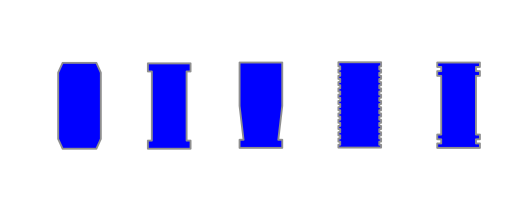
The most straightforward design is tapered pins, whos effective diameter reduces as they are lifted. This will cause another pin to bind before it's fully set, and require each pin to be picked multiple times, as well as providing frustratingly weak feedback.
Often, cheap locks act like they have tapered pins due to poor manufacturing.
Serrated pins have shallow grooves cut around their diameter. These can be manipulated the same way as standard pins, but each seration causes a click as it's lifted into the bible. This makes picking more confusing since a click doesn't necessarily mean a pin is set.
It's often easier to pick tapered pins with strong tension, since this makes them bind longer (and lift further) each time they are picked.
Spools allow the plug to rotate a few degrees without being set:
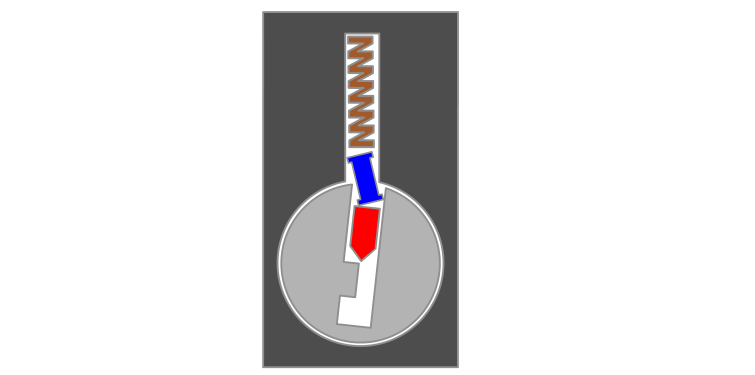
The state where all the standard pins are picked and the plug slightly rotates is called a false set. In this state, if a the spool pin is lifted, the plug will rotate backwards to let the bottom of the spool out.
Picking these is a matter of finding the pin that causes the most counter-rotation when tapped, and lifting that pin out of the plug. Annoyingly, this counter-rotation often causes other pins to drop down, which you will have to find and repick.
Since the pin edges are often slightly rounded, attempting to lift a keypin up into the bible will also cause counter-rotation. However, due to their geometry, spools provide more leaverage and produce stronger counter-rotation. (another way to tell when a pin is set is described in the next section)
Mushrooms act like spools, except that they must be partially picked before entering a false set. This allows them to be used in all pin chambers without introducing play when locked (which can make it hard to insert the key).
As for where these can be found, all but the worst deadbolts will feature a spool or two. Most higher-end padlocks will also feature spools. Mushroom pins are asymetrical, which complicates assembly, so are usually only found in high-end locks. Serrated and serrated spool pins are mostly found in "american lock" padlocks, and Assa really likes tapered pins.
... and how to open them:
As there name sudgests, security pins are hard. I recommend picking up at least two guttable locks: most any deadbolt will do. (another way to tell if a pin is) The "American Lock" 1100 series padlocks also come with a lot of security pins and I find them comfortable to hold.
The 1100 is pinned randomly, so it's possible to get one with all spools or all serrated pins. Getting multiple reduces the chance of such wierdness, and provides better practice. Also, they have strong core springs: if you are having trouble, try picking with the shackle open. Also also, expect a zero-lift pin somewhere. (more on that later)
The first lession won't actually involve security pins: while picking a lock with standard drivers, apply strong tension and lightly tap the key pins.
- An unset, unbinding pin will provide consisant spring pressure.
- A binding pin will have no springyness: the key hits the driver and stops, although it will have some free movement if the driver has been lifted. A binding spool will also produce couter-rotation on the plug.
- A set pin will have a tiny bit of spring pressure at the top of its travel. This happens because the key pin cannudges the driver pin, nether of which are binding.
- An overset key pin (lifted up into the bible) will not move easly or drop down due to gravity. If this happens, reduce tension until it drops down or reset the lock.
It's often easier to hear the difference than to feel it: Position a hook/diamond behind the pin, and pull it towards the front of the lock while lifting up. A set or unbinding pin will produce a small click as it's pushed down.
TLDR: If you feel or hear spring pressure, leave it alone. If you don't, pick that pin.
Take the locks apart and leave all but one pin chamber empty: remove the key pins, drivers and springs. Put the original key pin and a single spool inside the first or second chamber (from the front.)
Reassemble and pick the lock, paying very close attension to how much rotation the false set allows and what counter-rotation feels like. Take note of how much tension and pick pressure is needed to set it.
With that done, try pinning up another chamber with a standard (or serrated) driver. That pin will have to be picked first, after which the lock enters a false set and the spool can be picked. Doing so is quite likely to drop the other pin: this is why it's important to know how to test pin states.
Once you've opened that a few times, swap the order of the drivers around and pick.
Repeat the add-one-pin and pick process until you can consistantly open the lock at full difficulty. If your lock only had one or two spools, steal a few from the other lock to make it harder. Try putting all the spools in the front, or in the back, or spread around randomly.
Switching around the order of the key pins can provide more practice, this comes at the risk of getting locked out if you can't pick it. For this reason, I recomend switching between locks (with matching keys), at least until you can consistantly pick them.
Being sneaky with normal drivers:
One thing that can really confuse beginners is zero-lift pins: a pin stack that is set at the shearline before being picked.
While it might seem like a pin that doesn't have to be picked would make a lock easier, a set pin can feel similar to a binding pin, which makes it tempting to pick. Doing so will cause the long key pin to block the plug and force you to reset.
Some locks will have serations on the key pins which results in clicks and slight rotation as a pin is overset. This makes picking the zero-lift pin feel like making progress, even though it dooms the attempt.
To pick locks with zero-lift pins, it's important to:
- Know they exist.
- Learn how to feel the difference between a set and binding pin.
Another trick is placing a very low (or zero-lift) pin in front of a high cut pin. This can severely limit the amount of space to manover a pick, especailly if its near the back of a lock.
If your having trouble with a configuration like this, consider switching to center-of-the-plug tension: this frees up a lot of space below the pins. That space will also allow switching to a deep(er) hook for even more reach, and there's nothing wrong with swapping tools mid-pick.
If both of these fail, the final option is to overset the gatekeeper pin and then back of tension to selectivly drop it. This is tricky to get right, but can be usefull on locks with a tighter keyway.
Exotic pins:
This is, of course, only the surface of what lock makers can do. Some pins interact with a secondary (sidebar) mechanism and must be correctly rotated to open the lock. Others interact with "counter-milling" on the plug which allows multiple deep false-sets per pin and can require the picker to manually counter-rotate the plug to release them...
I can't describe all of them here, but if a lock is doing something weird, consider taking it apart: they may be something intresting inside.